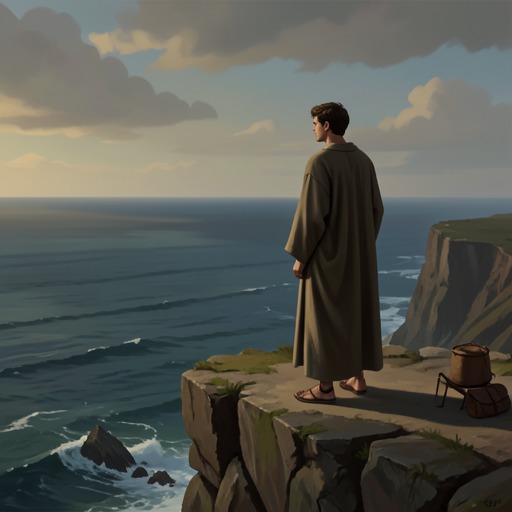
Dimitris Leaves the Monastery and Disappears on the Mountain
Cartes Postales from GreeceDimitris’s departure from the monastery culminates a long crisis in which private guilt overwhelms the religious life he had tried to use to contain it. After a woman’s confession reawakens memories of his teenage past, he can no longer find reassurance in prayer or the monastery’s images of salvation; he leaves for a bare mountain summit, where Giannis sees him surrounded by mist and then sees the mountain empty. The disappearance is presented without confirmation of what became of him, making the episode a turning point shaped by both psychological distress and unresolved uncertainty.
Background and the returning memory
Months before Dimitris leaves, a woman confesses in the monastery sanctuary. As she speaks, the quality of her voice recalls a voice that has troubled him for years. The memory brings back his teenage transgression, which he had tried to suppress, and the realization that his own guilt lies behind the distress he has been hearing changes the meaning of the confession for him. What began as another person’s account becomes an encounter with his own past.
The memory does not fade when the woman has gone. In the months that follow, Dimitris is repeatedly troubled by her voice and lies awake until two or three in the morning. He then spends the rest of the night praying on his knees, in a practice that leaves his back sore and brings him to tears. Confession, which he seeks for himself, does not release him from the burden or quiet the obsession. The account also connects the voice to Natalia: speaking with her had been the closest Dimitris had come to a sexual encounter, yet the shame of having been caught stayed with him and continued to haunt his dreams. The past is not simply remembered; it returns as a continuing source of distress.
A crisis of faith
The return of the memory unsettles the religious framework through which Dimitris has understood his life. For months, he struggles without finding relief, and the faces of the icons around him cease to seem kind. They appear reproachful instead. The change is not presented as a settled rejection of faith so much as the collapse of the comfort he once sought in it: neither confession nor prayer can make him feel that his guilt has been washed away.
After Giannis leaves the monastery, Dimitris comes out as well. He can no longer endure the saints looking down from the walls and ceilings or the surrounding images of heaven and hell, which seem to taunt him. The certainty that he will be saved has disappeared; he is no longer sure of his place in the religious judgment represented by sheep and goats. Even the familiar practices of coffee and confession seem to him potentially equal in their inability to help. His departure follows a spiritual impasse: the monastery’s sacred images, once part of his world, have become reminders of a judgment he cannot escape.
The climb and disappearance
Dimitris has sometimes spent nights in nearby caves associated with hermits seeking solitude. But retreating into those spaces has not brought peace; there, he feels he looks further into the darkness of his own soul. The words of the Gospel of Matthew concerning lustful thoughts follow him into the caves, making withdrawal from other people no escape from the moral accusation he hears within himself.
As darkness falls, he runs down a hidden path from the monastery and takes a detour up a nearby mountain, one that the monks have never built on. Its summit is clear of the religious images that have become unbearable to him. The mist encircles him there. The climb carries him away from the monastery but does not establish what he intends to do or what happens to him afterward; the narrative gives no further action or explanation from Dimitris himself.
Giannis’s sighting and the unresolved ending
Giannis, who has left earlier, is driving away when he glimpses the monastery, unlit and lonely, and then notices a solitary figure on a neighboring mountaintop. Mist and clouds move around the figure. Fog obscures him completely; moments later, after it clears, the man is gone and the mountain appears empty. Giannis turns up the volume on his radio and continues driving. His ordinary departure and onward journey contrast with the stillness and uncertainty of what he has witnessed.
The scene does not confirm that Dimitris has died, explain how he disappeared, or say whether the mist conceals an ordinary departure or something beyond ordinary explanation. Its ending therefore preserves ambiguity rather than resolving his fate. The narrator’s subsequent reflection links the episode to the isolation and physical and psychological strain associated with a priest’s vow of celibacy, while distinguishing solitude from loneliness through the Greek word monaksia, used for both. That reflection gives the disappearance a wider resonance, but the immediate cause remains the burden of guilt that Dimitris cannot quiet. The mountain offers distance from the monastery’s images, not a narrated answer to his crisis.